Sam Spade–Miles Archer partnership
The Maltese FalconSam Spade and Miles Archer’s partnership is both the practical framework of their detective agency and the basis for Spade’s response to Archer’s murder. The relationship is not presented as uncomplicated affection: Spade says he had discovered Archer’s faults early and intended to end their business arrangement. Yet, once Archer is killed, Spade treats the partnership as an obligation that survives his private judgment of the man. In the novel’s hard-edged world, professional responsibility—not admiration or loyalty in a sentimental sense—makes the killing impossible for him to ignore.
Identity and Working Arrangement
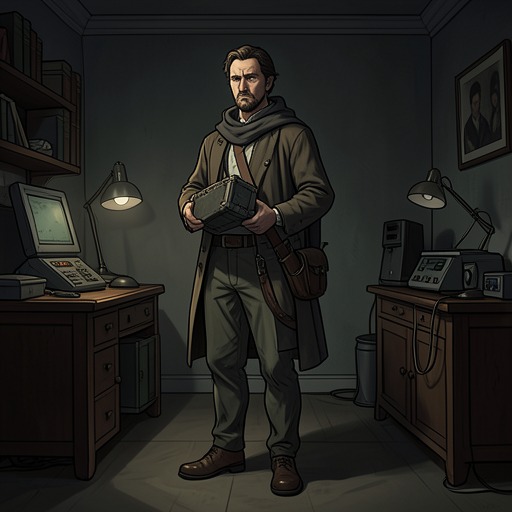
Archer enters the office as Spade’s partner while Brigid O’Shaughnessy is there seeking help. Spade introduces him by name and explains the assignment: O’Shaughnessy’s supposed sister has come from New York with Floyd Thursby, and the client wants the agency to find the sister and bring her home. Spade presents the case to Archer and checks the account with O’Shaughnessy, making clear that the two detectives are working jointly on the inquiry rather than that Archer is a stranger brought in after the fact.
The partnership depends on Spade’s ability to frame the client’s account and Archer’s participation in the work that follows. The early description establishes Archer as a mature, solidly built man, but the more consequential detail is his position within the agency: he is the colleague to whom Spade brings the new case. That ordinary introduction later gives the investigation a personal and professional stake that the client’s story alone could not provide.
Archer’s Murder and the Evidence
After Archer is shot in an alley, Spade examines the scene before the body is removed. Archer lies below a broken fence, near a boulder on the slope; the fence’s top rail has been torn loose, and investigators are moving along the ground with lights. From the position of the body and the damaged fence, Spade reconstructs a sequence: Archer was shot while standing near the fence, then fell backward through it and down the slope until the rock stopped him. Tom Polhaus confirms the reconstruction and adds that the shot burned Archer’s coat.
The physical scene is only part of what Spade must establish. Archer’s own revolver remains tucked at his hip and unfired, while more than a hundred and sixty dollars remains in his clothing. Those details complicate the possibility of robbery and make the identity of the shooter central. Spade tells Polhaus that Archer had been working, then explains that the agency had been trying to discover where Thursby lived. His guarded account shows that the killing has interrupted an investigation whose full purpose he is not yet prepared to disclose.
The police later report a direct ballistic link between the weapon found at the scene and Archer’s death. Polhaus says the bullet recovered from Archer came from the distinctive Webley-Fosbery revolver, which a hotel bellhop had seen in Thursby’s room that morning. That evidence supports the conclusion that Thursby shot Archer, although Spade challenges Polhaus’s certainty rather than simply accepting the police account. The relationship’s aftermath is therefore bound up with two related tasks: determining who killed Archer and deciding what the detective owes his murdered partner.
Professional Duty and Conflict
Spade’s response to the murder is inseparable from the police investigation. When Polhaus and Lieutenant Dundy confront him, Spade’s exchanges with the officers are tense; he demands to know what Dundy wants and resists being treated as though the police can dictate his conduct. Their pressure matters because Spade is not only investigating a death. He is also a possible suspect and must navigate the authorities while protecting his own professional position.
His dealings with Joel Cairo further place the partnership inside the wider criminal case. Spade tells Cairo that the killings have left Cairo implicated in a way the police could use, and uses that vulnerability to insist that Cairo cooperate. The investigation that began with O’Shaughnessy’s account of a missing sister has widened into the pursuit of the falcon and the people connected to it. Archer’s murder is not a detached tragedy alongside that pursuit: it is the event that makes the agency’s work a matter of professional accountability.
The case also exposes how information travels through an unstable network of alliances. O’Shaughnessy says Thursby had met her in the Orient and had promised help before betraying her. She later admits that she helped the others try to obtain the falcon from a Russian named Kemidov. Spade’s account of events aboard the La Paloma places O’Shaughnessy with Captain Jacobi and, later, Gutman, Cairo, and Wilmer Cook; the group talks in Jacobi’s cabin, where a shot is heard that night. Gutman eventually explains that Thursby was O’Shaughnessy’s ally, that his removal was meant to weaken her position, and that Thursby remained loyal to her when Gutman tried to make a deal. These disclosures show the case moving through shifting partnerships and betrayals. Spade’s own partnership with Archer becomes the standard against which he evaluates the duty created by Archer’s death.
A Partner’s Killer and Spade’s Rule
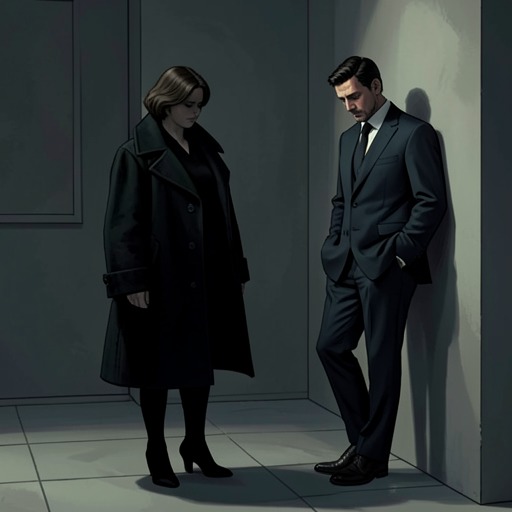
When O’Shaughnessy appeals to Spade by arguing that Archer had faults, Spade does not deny it. He says he recognized during their first week in business that Archer was a poor partner and had intended to end their arrangement when the year was up. He also rejects the idea that Archer’s death did him personal harm. The distinction is decisive: Spade’s pursuit is not founded on a claim that Archer was virtuous, indispensable, or loved. It follows from the position Archer occupied in the business.
Spade articulates that reasoning as a chain of professional obligations. A partner’s killing calls for action regardless of what the surviving partner thought of him; in a detective agency, allowing the killer to escape is bad for the organization and for detectives more broadly. Spade compares a detective who catches criminals and then lets them go to a dog that catches a rabbit and releases it. His argument makes the pursuit of Archer’s killer an element of the detective’s occupation, not a personal revenge plot that can be set aside by affection or dislike.
That sense of obligation meets Spade’s practical approach to law enforcement. While negotiating with Gutman, Spade insists that he must be able to hand the authorities a culprit when the reckoning comes. He describes a fall-guy strategy as the condition that has allowed him to defy officials and still remain protected by his ability to produce a criminal. The method is pragmatic and morally limited: it is not a promise that every part of the case will be made just, but a rule that he must not be left without someone to deliver to the police. In that framework, Archer’s murder cannot simply be absorbed into the larger bargain over the falcon.
Meaning and End of the Partnership
The partnership ends in practice with Archer’s death, but its consequences continue to govern Spade’s decisions. He tells O’Shaughnessy that he could have let her go only by also letting Gutman, Cairo, and Wilmer go. His decision to turn her over is therefore connected to the wider network of people involved in the case, not only to the identity of Archer’s killer. The duty he derives from the partnership extends into the handling of the whole criminal situation.
The relationship’s central irony is that Spade can acknowledge Archer’s shortcomings without treating those shortcomings as permission to abandon the obligations attached to him. He had planned to dissolve the partnership; murder makes that unrealized plan irrelevant to the immediate question of what a partner must do. The novel uses their relationship to distinguish private regard from professional conduct: Spade need not admire Archer to insist that the killer be pursued. The partnership survives not as a continuing business but as a claim on Spade’s actions, and that claim helps determine the ending of his dealings with O’Shaughnessy and the others.